
Global food prices will come under further pressure on Monday as benchmark prices for cereals at much higher levels come into operation, making it almost inevitable that a second wave of food price inflation will hit the world's leading economies.

With the start of rabi crop arrivals, the prices of agri commodities have declined in the past two months, raising hope that food prices will moderate in the weeks ahead.

Nepal has launched a diplomatic initiative to secure climate-related compensation from major greenhouse gas emitters, asserting that post-disaster assistance for recent deadly flash floods should be viewed as a moral and legal liability, not charity. Foreign Minister Shisir Khanal highlighted Nepal's disproportionate suffering from global warming despite negligible emissions, citing rapid glacier melt and extreme mountain disasters. The country has formally approached the Loss and Damage Fund board for urgent financial aid following a catastrophic flash flood in the Bhotekoshi river basin.
The FAO's food index of 55 items averaged at 209.3 points in April this year, down by 1.6 per cent from March and 3.5 per cent below April 2013.

'Improved law and order and transparent governance have helped change UP's investment image.'

Concerned over rising food prices, planning commission deputy chairman Montek Singh Ahluwalia on Monday pitched for increasing supplies through imports and better use of the public distribution system.
Food prices in India, which rose an annual 18 percent in January, have started falling and will dip further next month, Agriculture Minister Sharad Pawar said on Wednesday.
CII opines that a global discussion on the crisis might help building stronger information netwrorks on consumption and production so that corrective measures can be taken across the globe to avert such a crisis. It also advised to develop global food management system under Food and Agricultural Organisation.

Global food prices rose by 1 per cent in March as compared to the previous month, driven mainly by an 11 per cent increase in dairy products.

The Small Animal Hospital, which provides world-class treatment to pets and strays alike, continues Ratan Tata's legacy.

The International Monetary Fund (IMF) has reduced India's growth forecast for FY27 to 6.4 per cent, citing the potential impact of higher energy prices offsetting the country's economic resilience. Despite this, India remains among the fastest-growing major economies.
High domestic food prices are still a cause for concern despite India hugely benefiting from a slump in global oil and commodity prices that pushed inflation into negative zone, the Economic Survey said.

Food inflation touched 17.40 per cent for the week ended January 16 on account of high prices of vegetables and pulses.
Prime Minister Manmohan Singh said that rising food prices would make inflation control a more difficult task and it has the potential to derail economic reforms. "We in India too are deeply concerned about rising global commodity and food prices. . . a steep rise in food price will make inflation control more difficult and can thereby hurt the cause of macroeconomic stability. The constituency for economic reforms, so necessary for growth, would also diminish," the PM said.
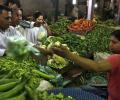
'If you see the composition of items which are causing this spike in prices, most of them have little to do with the kharif harvest, except for pulses and vegetables to some extent.' 'I don't know on what basis the government is claiming that food prices will moderate in the weeks to come.'
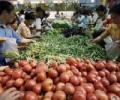
The Economic Survey tabled today in the Lok Sabha by the Finance Minister Shri Pranab Mukherjee, says that the whole sale price index (WPI) of food inflation rose to 13.6 per cent in December 2010 on account of unfavourable agricultural supply conditions coupled with the waning of base effects.
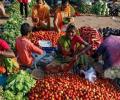
The wholesale price-based inflation eased for the second consecutive month in January at 12.96 per cent, even though food prices hardened, the government said on Monday. WPI inflation has remained in double digits for the tenth consecutive month beginning April 2021. Inflation in December 2021 was 13.56 per cent, while in January 2021, it was 2.51 per cent.
The output of pulses and oilseeds in 2012-2013 is likely to fall by 14.61 per cent and 9.62 per cent, respectively, says the first official estimate of kharif season. Experts warn this could trigger a spike in food prices.

Food inflation is expected to cool off in the next two months from the current high of about 18 per cent on expectation of better Rabi (winter) crop, Prime Minister's economic panel member said.

On a year-on-year basis, Wholesale Prices-based inflation in December 2009 was 7.3 per cent, while food inflation was 19.77 per cent
Data earlier on Thursday showed the annual consumer price inflation rose to a higher-than-expected 11.24 per cent in November from 10.17 per cent in October.

Food inflation rose to 17.47 per cent in the third week of November against 15.58 per cent in the previous week.

Inflation dipped to a five-month low of 5.19 per cent in July mainly on account of decline in prices of some food articles, vegetables and protein rich items.

Hindustan Unilever (HUL) exceeded consensus estimates in Q4FY26, driven by lower overheads and 6 per cent consolidated volume growth. However, the company anticipates further price hikes to counter an expected 8-10 per cent material cost inflation, while maintaining a mid-term margin guidance of 22.5-23.5 per cent.

Fast-moving consumer goods (FMCG) companies are closely monitoring crude oil prices and considering low single-digit price increases, while consumer durables firms have already begun passing on significant price hikes to consumers due to rising input costs exacerbated by the West Asia conflict.

Researching Japan was like going down a rabbit hole. There is just so much to see and do, but I finally decided we would stick to the 'Golden Route' of Tokyo, Osaka and Kyoto, notes Radhika Mittal.
Both the surging food prices in 2007 and 2008 and their subsequent drop in some areas are a result of large-scale speculation by financial investors, a new report by the United Nations trade body says, calling for greater regulation to protect millions of poor people worldwide.

We raid restaurants for cockroaches but never raid the roadside. Public hygiene runs entirely on faith and fumes. Even after so many years of being a free nation, points out Binu Alex.

Rising oil prices and firming up of global and domestic food prices are likely to have a significant impact on inflation outlook in 2011, a top RBI official said.

Fitch Ratings forecasts a 9 per cent aggregate revenue increase for rated Indian corporates in the current fiscal year (FY27), a stronger outlook compared to the 5 per cent estimated for FY26, which is expected to keep credit metrics stable despite potential global and domestic challenges.
The new figures released by the United Nations Food and Agriculture Organisation on Thursday ahead of next week's General Assembly meeting on global anti-poverty targets known as the Millennium Development Goals, show that the number of people suffering from hunger is now roughly 925 million.
Titled as 'Global Food Price Inflation and Developing Asia', the report claimed that a 10 per cent rise in domestic food prices could push 64 million Asians to subsist below the poverty line level of $1.25 a day.
Higher local output estimated to depress cross-border sales
Decline in planting of cereals across the world may lead to volatile food prices next year, the Food and Agricultural Organisation (FAO) of United Nations has said in its latest report.

Indian stock markets this week will be primarily influenced by a series of corporate Q1 earnings, the evolving geopolitical situation in West Asia, and fluctuations in crude oil prices, according to market analysts.
Consumers are unlikely to get relief from high food prices till December 2012, despite a modest increase in global foodgrain production.

Eternal's quick commerce platform, Blinkit, significantly outperformed in Q1 FY27, with net order value (NOV) rising 19.1 per cent quarter-on-quarter, indicating strong market share gains driven by increased monthly transacting users and transaction frequency.

Citing the sharp rise in food prices, economists at a foreign bank have forecast a steeply higher retail inflation print for July, pegging it at 6.7 per cent, up 190 basis points from the previous month. Deutsche Bank India economists led by chief economist Kaushik Das, in a report on Monday ahead of the monthly inflation print and the Reserve Bank's monetary policy review, said that the July consumer price-based inflation index (CPI) is likely to print at 6.7 per cent on-year as against 4.8 per cent in June. The Reserve Bank is widely believed to leave the key interest rates unchanged for the fourth time in its upcoming bi-monthly monetary policy decision on August 10.

Obama was responding to a question as to what his administration is doing to keep the ethanol plant.

Global food prices rebounded in January this year demonstrating the volatility in the international food markets, after falling for six months since July, 2011, United Nation's body FAO said on Friday.
